
Whip
Introduction
A whip is a single-tailed implement, usually made of braided leather or nylon, designed as a tool for working with livestock, for competition and performance, or for BDSM impact play.
A whip’s length, flexibility, and tapered design allows it to be thrown in such a way that, toward the end of the throw, part of the whip exceeds the speed of sound — thereby creating a small sonic boom. This makes the whip most likely the first human-made object to break the sound barrier. Despite common belief, the bullwhip was rarely if ever used to actually strike cattle, as this could cause serious injury to the animal.
For a good introduction to whips, see: Trinity Whip Co.
History
The origins of the whip are a matter of ongoing debate, and given the perishable nature of leather, are likely to remain so. Difficulties in tracing its development also arise from regional and national variations in naming. There are claims that it was developed in South America, where — like “cow-whips” during the slave trade — it was used as a weapon. Others suggest it arrived in the Americas from Spain.
Roman mosaics and earthenware dating to around the 2nd and 3rd centuries AD show what appear to be tapered drop-lash whips, rather than the two-piece whips more commonly associated with Roman and other ancient cultures. Given that the same basic design appears across several independent primary sources, it seems likely that this reflects an actual design in use at the time rather than a stylistic coincidence.
Safety
The first step is to respect a whip — it is a loaded weapon and must be treated as such. Before using a whip around others, make sure you understand how to handle it safely and have practised in a clear space.
- Protect the eyes — Always wear safety glasses when practising, and ensure any bystanders are also protected.
- Protect the head — A hat can help protect your scalp during overhead cracks.
- Protect the skin — Wear long sleeves and long pants when learning, as misdirected cracks can cut or bruise.
- Bring a first aid kit — Cuts and abrasions can happen, especially when learning new techniques or using an unfamiliar whip.
- Know your surroundings — Always check your space for people, animals, and obstacles before cracking.
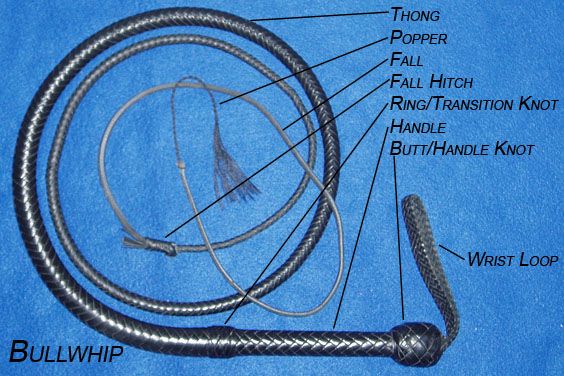
Whip anatomy
The diagram below shows the main parts of a whip.
Types of whips
- Snake whip — A small, flexible whip with no rigid handle. The entire length is supple, making it easy to coil and carry.
- Bullwhip — The most common and well-known type of single-tailed whip. Features a rigid handle and a long braided thong. Available in a wide range of lengths.
- Stockwhip — A whip with a long, flexible handle attached to a shorter thong. Traditionally used in Australian cattle herding.
- Cowwhip / Performance whip / Hybrid — Variations of the bullwhip designed for performance, competition, or specific regional use. Often lighter and more responsive than traditional bullwhips.
- Signal whip — The smallest type of single-tailed whip, with a built-in cracker at the tip. Quick and precise, popular for beginners and performance artists.
- Bullock whip — A heavy-duty whip traditionally used with bullock teams. Typically longer and more robust than a standard bullwhip.
- Fire whip — A whip made with a cotton and Kevlar blend, designed to be set on fire for fire performance. Requires specialized safety training.
Whip cracks and tricks
Below is a selection of foundational cracks and techniques, with video tutorials from experienced whip artists.
- Cattleman crack — One of the most fundamental cracks, a great starting point for beginners.
- Cookie cutter — A circular crack that loops around the body before cracking in front.
- Overhead crack — A classic crack thrown from directly overhead.
- Reverse overhead crack — The overhead crack thrown in the opposite direction.
- The flick — A fast, tight crack using a short, snapping motion.
- Slow figure eight — A flowing figure-eight motion that builds control and coordination.
- Overhead flick — A flick variation thrown from an overhead position.
- Elevator crack — A vertical crack where the whip travels straight up and down.
Whip makers and resources
- Montreal whip maker (FetLife) — Montreal’s best local whip maker, active in the community and making high-quality custom whips.
- David Morgan — One of the most respected whip makers in the world, known for exceptional craftsmanship and a wide range of styles.
- Midwest Whips — Another excellent maker offering a solid selection of hand-crafted whips at various price points.